

Changing from cassava to corn: define the operating envelope
A feedstock conversion changes more than the receiving equipment. Qualify the raw material, front-end duty, fermentation behavior and co-product route together.
CNE — China New Energy · Updated ·
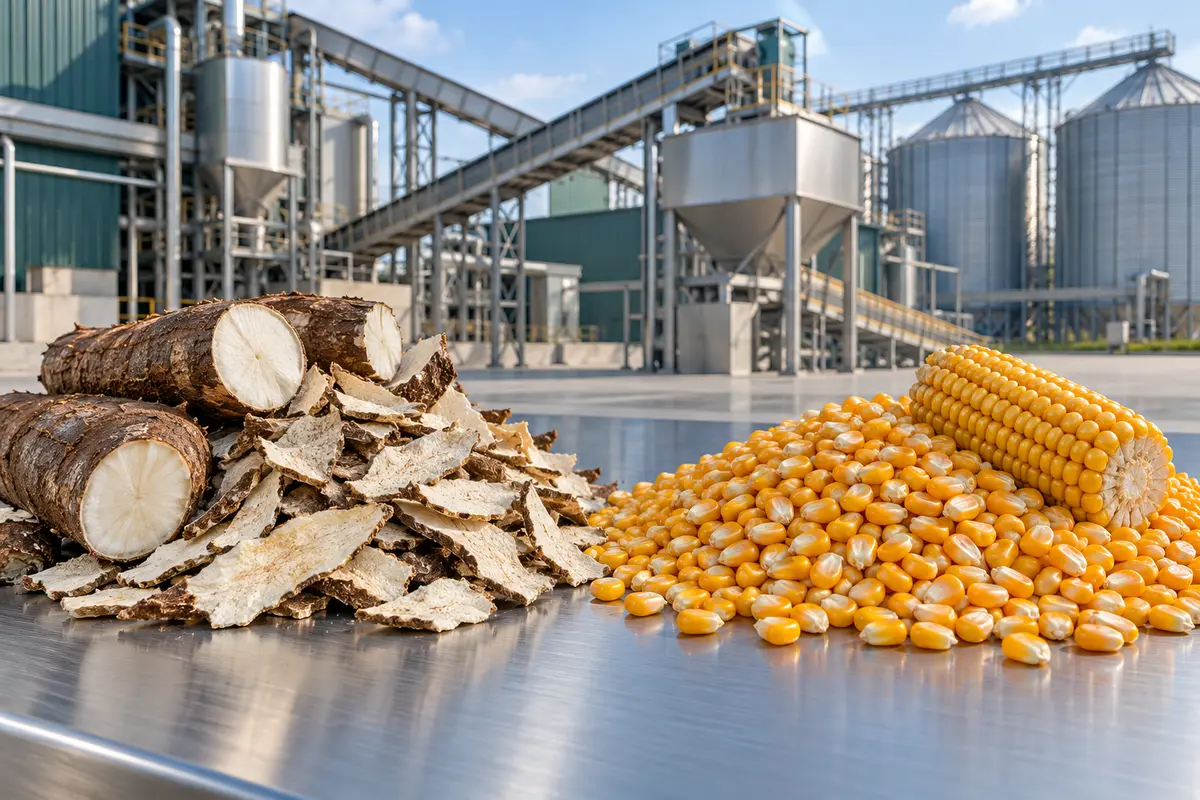
AI · Process illustration — not a site photograph
01 /
Qualify representative feedstock
Use analyses that represent the intended supply, including seasonal variation. Record moisture, starch, protein, fiber, ash, fat and relevant contaminants, and state whether each value is on an as-received or dry basis. Sampling and storage conditions matter: one supplier sample cannot establish the variability of a year’s deliveries.
02 /
Check front-end and fermentation interfaces
Confirm receiving, cleaning, milling and slurry-preparation duties for the new material. Changes in particle distribution and solids loading influence mixing, pumping and conversion. Liquefaction and saccharification conditions depend on the selected enzymes and approved process design. Fermentation planning should address usable sugar, cooling duty, contamination control and the laboratory measurements used to follow the batch.
03 /
Close the stillage and water balances
Corn dry-grind processing links ethanol production to stillage separation and co-product recovery. Confirm the intended wet or dried feed product, its market specification and the available evaporation and drying capacity. Trace recycled streams, fresh-water input and wastewater destinations. A downstream bottleneck can limit the whole line even when the upstream sections can briefly run at higher load.
04 /
Inspect equipment before assigning reuse
Review condition, materials, corrosion allowance, internals, allowable loads and operating history. Reuse decisions should distinguish unchanged duty from modified duty. Connect the equipment list to tie-in drawings, control changes, shutdown work and the relevant inspection records.
05 /
Verify the upgraded production route
Define representative raw materials, the product specification, a stable operating period and the measurement boundaries before the performance test. Coordinate the test plan with laboratory sampling, utility readings and equipment handover documentation.
Further technical reading
Updated · 2026-10-11
Continue exploring
Stillage evaporation & DDGS systems
Coordinate solids separation, thin-stillage evaporation, syrup blending and drying around a defined co-product specification. DDGS is a process system, not a general accessory; a molasses stillage route requires a different residue strategy.
Explore ↗Revamp an idle distillery for a new feedstock

An existing plant has useful equipment and inherited constraints. A feedstock change starts with a condition survey and a complete mass balance, not a replacement list alone.
Explore ↗PT IEI, Indonesia | Corn-Based Ethanol Plant Upgrade
From cassava to corn: CNE integrates process design, new and existing equipment, and on-site commissioning support for PT Indonesia Ethanol Industry.
Explore ↗Your next plant starts with the right conversation.
Share your feedstock, target product and capacity. Let’s shape a practical process concept.
